
How RCI helps your company buy better
Six jobs the platform does, each one written for the person who owns it.
What should we push back on before we sign
For the procurement lead
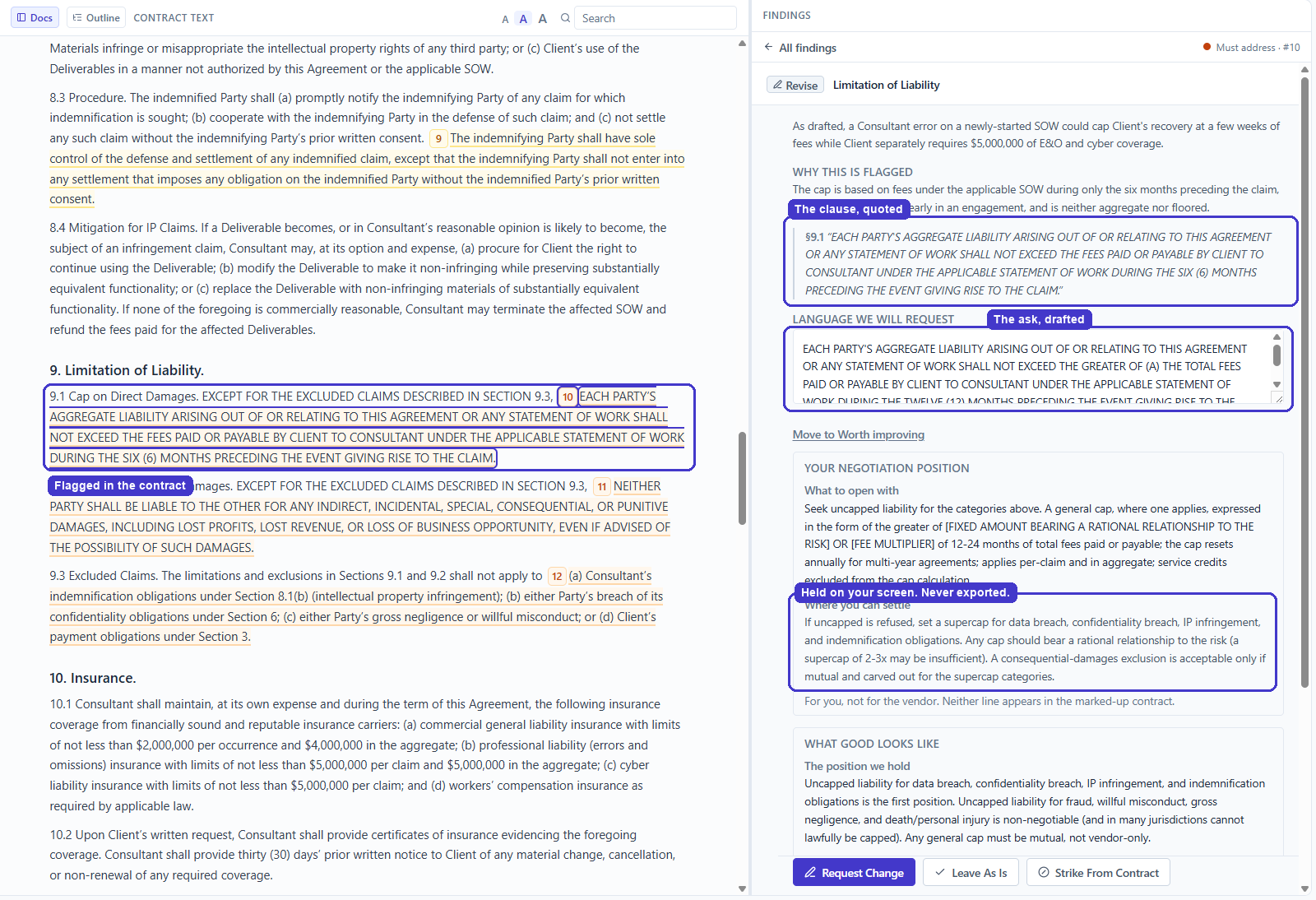
The vendor sent their paper and the clock is running. You need to know what to push back on, what to ask for instead, and what is genuinely fine to leave alone, before the next call, not after three weeks in a review queue. RCI reads the full contract against your standards and hands you the negotiation, not just the problems: every finding arrives as an ask aimed at the vendor, with your opening drafted and your settlement floor held on screen and nowhere else.
- Walk into the next call with a position on every finding: what to change, the drafted replacement language ready to send, and where you can concede
- Show your CFO the coverage receipt, every standard checked including the ones that came back clean, so “we reviewed it” means something specific
- Every flag carries the contract’s own words quoted next to it, so you can verify the finding yourself before you raise it with the vendor
- When their redline comes back, your earlier decisions carry forward: you re-review what changed, not the whole document again
What did we actually sign
For the GC and internal audit
The contracts in your book were reviewed at signature, against whatever the standards were then, by whoever had time. Your standards have moved and the book has not been read since. RCI evaluates executed contracts exactly the way it evaluates live ones: the full text, against your current standards, with a receipt. Your back catalog isn’t dead weight; it teaches the platform how your company actually buys.
- Put a coverage receipt in front of the auditor: every executed contract read in full against current standards, with what was checked and what came back clean on the record
- Every deviation cites the signed contract’s own language, so the finding is verifiable evidence, not an opinion
- Findings arrive ranked by what must be addressed, so remediation starts with the terms that carry real exposure
- Export the marked-up contract and the review summary as the audit artifact, ready for the file
- The record itself is append-only: every action attributed, every round preserved, nothing editable after the fact
What is renewing and what are we doing about it
For the owner of vendor spend
The renewal terms that govern your spend are buried in documents nobody opens until the notice window has already closed. RCI reads the book, puts every renewal and notice deadline on one calendar, and hands you a re-read contract with drafted asks in time to use the leverage a renewal gives you.
- One calendar of renewal dates and notice windows across the whole book, pulled from the contracts themselves, so the standing CFO question has a standing answer
- Arrive at each renewal with the contract freshly evaluated and the change requests drafted: leverage used, not lost
- See where spend concentrates and where vendor risk sits, so renewal decisions are prioritized by exposure, not by whichever deadline arrives next
- Decisions made at this renewal carry into the next round and the next term, so the book gets easier to run every cycle
Active contracts
248
across 37 vendors
Committed value
$18.4M
across portfolio
Evaluated
214 of 248
of portfolio reviewed
Must address
43
awaiting a decision
Financial concentration · committed value by vendor
Composition · by contract type
What’s coming up · renewals and expirations
6
30 days or less
Urgent
9
31 to 60 days
Soon
11
61 to 90 days
Upcoming
41
Beyond 90 days
Watch
Risk concentration · by vendor
Helix Cloud Services, Inc.
$4.2M · 14 contracts
Kestrel Software, Inc.
$3.1M · 9 contracts
Aldridge Advisory Group LLC
$2.6M · 6 contracts
Emergent findings · across the book
AI training rights over customer data
6 hitsAuto-renewal with shrinking notice window
4 hitsLiability cap below insurance coverage
3 hitsPatterns the platform noticed that no standard asked about. Your team decides what joins the playbook.
Does the contract actually require it
For third-party risk
Your vendor assessments run on questionnaires, but the contract is what the vendor is actually bound to, and it is the one document the process never reads. RCI reads each vendor agreement in full against the provisions your third-party risk program requires and returns evidence you can put in the assessment file.
- Answer “show me where the contract requires it” with the clause quoted verbatim, or with a documented finding that the contract is silent: either way, it is on the record
- The coverage receipt lists every requirement checked per vendor, so the assessment shows its work
- Vendor risk across the book in one view, so the tiering conversation with your CISO starts from what the contracts say, not what the questionnaires claimed
- Where a contract falls short, the drafted replacement language is ready for the next renewal or amendment conversation
There is a newer reason to read every word: vendors increasingly draft with generative AI, and generative tools are additive by nature. The paper gets longer, clauses appear because a model thought they sounded contractual, and obligations that have no business in your deal ride in with the boilerplate. Most review tools are additive too: they only suggest what to insert.
RCI was deliberately built to work in both directions. Every finding is directional, and one of the directions is strike: when a clause should not be in the contract at all, the platform says so, shows you why, and carries the strike-through into the marked-up contract. Reading for what does not belong is painstaking work, and it is exactly the work a bloated, AI-drafted contract counts on nobody doing.
Which contracts does the new law touch
For compliance counsel and audit practices
A new statute changes what your vendor contracts must say, and the only honest way to know which ones are affected is to read them all again. RCI makes the sweep a matter of updating your standards once and re-reading the book against them, with a record of exactly what was checked.
- Scope the sweep with search across the whole book first: titles, vendors, and the full text of every contract, by keyword or by meaning
- Encode the new requirement into your standards once; every contract you sweep is read in full against it, executed agreements included
- Get back the affected list with the gap quoted from each contract, and the contracts that already comply documented as clean, not merely absent from the list
- Drafted amendment language per finding turns the sweep directly into the vendor outreach: no second drafting project
- Risks your standards did not anticipate surface as emergent findings with how often they recur, so the sweep also tells you what your playbook is missing
The same sweep serves the firms that do the auditing. Risk and compliance practices at accounting and advisory firms read client vendor books the same way: encode the framework once, run the book, and hand the engagement team findings with the evidence quoted and a receipt of everything checked, client after client.
Emergent Watch
sample dataConcerns the review raised that your playbook does not name. A concern that recurs across contracts is a candidate to add.
Adverse Criticality Admission
Should haveThe contract concedes the services are mission-critical while the vendor commits only to best efforts.
Advisor Conflict of Interest
Should haveThe firm advising whether to migrate is paid to run the migration if the client proceeds.
Liability Cap Below Insurance Coverage
Should haveRecovery is capped near six months of fees while the client requires millions in E&O coverage.
What is really in the target's contract book
For deal teams and operating partners
A deal team is not buying software. You are buying a company, and with it every deal that company ever signed: the auto-renewals already in flight, the change-of-control consents you now owe, the uncapped exposure nobody priced into the model. Diligence samples the top of the book and hopes; the risks live in the contracts nobody had time to read.
RCI reads every agreement in the room in full, against your diligence standards, and puts the money on the findings: assignment and change-of-control provisions flagged with the consent they require, committed value mapped vendor by vendor, notice windows that fall inside the closing timeline surfaced before they fire. When the deal closes, the same read becomes the map for rationalizing the book you just inherited.
- Every contract read end to end against your diligence standards, with a coverage receipt that turns “we sampled” into “we read it all, and here is what was checked”
- Findings cite the target’s own contract language, so the issues list in the deal memo is verifiable by anyone who opens the source document
- Post-close, the portfolio view shows composition, financial concentration, and vendor risk across the combined book: the starting map for rationalization
- The renewal calendar on the inherited book shows which decisions have deadlines attached, so exits happen at the window instead of a year later
Contracts read
All of them
Committed value mapped
$12.6M
Flagged for the deal memo
47 findings
Change of control requires vendor consent
Assignment clauses in key agreements need counterparty consent before the deal closes.
Auto-renewals firing inside the closing window
$2.1M renews automatically unless notice is given; the nearest notice window closes soon.
Uncapped exposure nobody priced
Indemnity obligations with no cap found in executed agreements the data room summary never mentioned.
The cost of exit, quantified
$4.2M of committed spend carries no termination for convenience; leaving means paying.
Concentration in the combined book
Two vendors hold half the committed value once the books merge; the leverage conversation starts there.
Standards your company controls
All six jobs run on the same foundation. Most companies have standards in their heads, not on paper; RCI codifies your contract playbook, starting from a baseline built with veteran procurement advisors and layering your company’s own positions on top: your industry, your risk posture, your contract types.
- Every contract is read against the same bar, no matter who on your team handles it
- Every decision your team makes teaches the platform what good looks like for your business; the work compounds
- Every finding shows what good looks like for that clause and why the standard exists, so the review teaches whoever is reading it
- Patterns that recur across your contracts but aren’t in your standards surface with a count; your team decides what joins the playbook
- Your standards and your decisions stay yours: workspace-isolated, stored as plain prose, exportable in full
And the boundaries hold across all of it: RCI is not a CLM, not a substitute for counsel, and never acts without your team. The full is-and-is-not list lives on the homepage.