
Inside RCI
How the platform works, for the reader who wants to look under the hood.
What it is
Revver Contract Intelligence is AI contract review that takes the buyer’s side of the table. What your team gets is concrete: a senior-caliber read of every vendor contract before anyone opens the file, findings ranked by severity with the evidence quoted and the fix already drafted, a receipt showing everything that was checked, and a marked-up contract ready for the vendor when the deciding is done. Review stops being the bottleneck, coverage is shown instead of assumed, and the redline that goes out reflects how your company buys, not who happened to catch the file.
Underneath, RCI is knowledge architecture. The standards library encodes institutional procurement judgment: what good looks like on every term, codified with veteran advisors who spent decades on your side of the vendor table. The learning loop encodes your own: every decision your team makes feeds the next read. AI-assisted contract analysis is the output. The asset is your institution’s contracting judgment, captured and compounding instead of walking out the door.
This page describes how it actually works: the evaluation, the standards, the learning loop, the review workspace, and how your data is handled. It exists because some buyers want the mechanism, not the brochure. If that’s you, read on.
What happens when a contract is uploaded
The platform first works out what it’s reading: what kind of instrument this is, what family it belongs to. From the standards library, the applicable standards are selected deterministically for that contract type. No one assembles a checklist by hand, and the selection doesn’t depend on who’s running the review. The deal’s commercial facts, vendor, term, fees, notice windows, renewal mechanics, are extracted at upload and sit on the workspace, editable in place.
Then the read. The platform reads the entire contract in a single pass, with full reasoning, the way an experienced reviewer reads a deal: front to back, holding all of it at once. Cross-clause reasoning happens here, because it can’t happen any other way: how the limitation of liability shapes the indemnification, how the termination provisions change what the auto-renewal really means, how the SLA remedies depend on what the audit rights actually allow. If the document is a statement of work under a master agreement, the platform walks the document family first and reads with the parents in context, so it knows what the SOW inherits before it flags what the SOW lacks.
Only after the read does the platform settle its findings against the selected standards. A completeness gate enforces that every standard is accounted for; an evaluation that can’t account for its full scope fails loudly rather than returning something that looks finished. The order matters: an engine that checks requirements one at a time produces a coverage report with no view of the deal. RCI forms a view of the deal, then produces the coverage as a receipt.
Every evaluation produces three things at once:
The coverage receipt
Every standard checked, including the ones that came back clean. “We looked, and it’s fine” is information a checklist never gives you.
The findings
Each one directional, ranked by severity, carrying the verbatim contract language it rests on, drafted replacement language, and a negotiation position.
The assessment
A plain-language read of the whole deal: what this contract is, what the vendor is trying to do, where the risk concentrates.
Plus the emergent findings: things the platform noticed that no standard asked about.
Findings are proportionate to the deal. A standard that is technically absent but immaterial at the deal’s size is recorded on the receipt as considered, with the reason, instead of being inflated into a phantom ask. That judgment is on the record, and your team can override it.
The receipt speaks in verdicts, not scores: satisfied, weak, absent, deviates in your favor, violated by presence. That last one exists because contracts fail in both directions: sometimes the problem is a missing protection, and sometimes the problem is a clause that should not be there at all. When the verdict is violated by presence, the drafted remedy is a strike, and the marked-up contract carries the strike-through. And when a term deviates in your favor, the verdict is recorded and the platform stays silent: it will never volunteer language that fixes the vendor’s mistake.
When the vendor sends a revision, the platform doesn’t start over. It reads what changed against the live state of the negotiation, so round two begins from what your team already settled. A full re-read remains available whenever you want one.
One read
The whole contract in a single pass, with full reasoning: clauses read together, the way a senior reviewer reads a deal. What comes out is checkable against the document, line by line.
Then the loop
Every decision your team makes flows back into your decision history, and the next read starts smarter than the last. Your playbook stops being a document someone wrote once. It compounds.
One read of the whole deal
Full reasoning, front to back, cross-clause.
The coverage receipt
Everything checked, including what came back clean
The findings
Ranked, evidence quoted, replacement language drafted
The assessment
What this deal is and where the risk concentrates
Your team decides every finding
Each decision rides the rail back up: input to the next read
Codified standards, the foundation
The platform doesn’t evaluate against whatever a model happens to know. It evaluates against codified standards: structured prose describing what good looks like, requirement by requirement, written to be read by a reasoning model and by a human.
The baseline was codified with veteran procurement advisors from decades of practice. Your company’s standards layer on top: your industry’s requirements, your risk posture, your contract types. In healthcare that means business-associate and data-handling terms; in financial services, audit rights and subcontractor flow-downs; wherever you buy, the clause families your world actually runs on. Both layers are read the same way in every evaluation, and both are scoped to your workspace.
Standards are stored as plain prose, not as embeddings or prompt fragments tied to one model’s quirks. That choice looks small and isn’t; “Your knowledge outlives any model” below is about why.
And the standards are applied as an advocate, not a fairness engine. When a term deviates in your favor, the receipt records that it was checked, and the platform says nothing to the vendor. It will never volunteer language that fixes the other side’s mistake.
The learning loop
Every decision your team makes in the platform is recorded in an append-only decision log: the changes requested, the language edited, the findings your team chose to leave alone, the notes explaining why. Future evaluations retrieve from that record, most specific first: what your workspace has decided, then what your organization has decided, then the expert baseline. Retrieval is keyed two ways at once: by the exact standard a decision was made against, and by meaning, so a correction made on one vendor’s indemnity language can inform the read of another vendor’s, phrased entirely differently, without ever leaving your walls.
The effect compounds quietly. The platform’s read of your next contract is informed by every one before it: the language your team prefers, the trade-offs your company accepts, the positions that have worked. Your standards stop being a document someone wrote once and become the operating record of how your company actually buys.
Nothing about this crosses customer boundaries. Your decisions inform your evaluations, no one else’s.
The loop is also protected from learning the wrong lessons. A concession made to close one deal is recorded without becoming doctrine, corrections can be withdrawn, and nothing enters your playbook without a human deciding it belongs there.
Emergent findings
Standards catch what you know to look for. The platform also records what it noticed that no standard asked about: a clause type it hasn’t seen in your book before, a risk pattern recurring across your vendors, terms shifting in the market’s paper. These surface in their own view with a count of how often each has appeared. Your team decides what joins your playbook and what gets dismissed as noise. The system tabulates; the team decides.
Emergent Watch
sample dataConcerns the review raised that your playbook does not name. A concern that recurs across contracts is a candidate to add.
Adverse Criticality Admission
Should haveThe contract concedes the services are mission-critical while the vendor commits only to best efforts.
Advisor Conflict of Interest
Should haveThe firm advising whether to migrate is paid to run the migration if the client proceeds.
Liability Cap Below Insurance Coverage
Should haveRecovery is capped near six months of fees while the client requires millions in E&O coverage.
Your knowledge outlives any model
RCI is built so your accumulated judgment is a durable asset, not a sunk cost inside one AI vendor’s stack. Standards, decisions, corrections, and notes are all stored as human-readable prose with metadata. Embeddings accelerate retrieval; they are never the source of truth. When a better model arrives, the platform adopts it and re-reads from the same prose without losing anything. When you want your data, you export all of it: contracts, evaluations, decisions, standards.
Knowledge is stored as prose, not weights. The AI model is a component, not a dependency. The durable asset is yours.
The review workspace
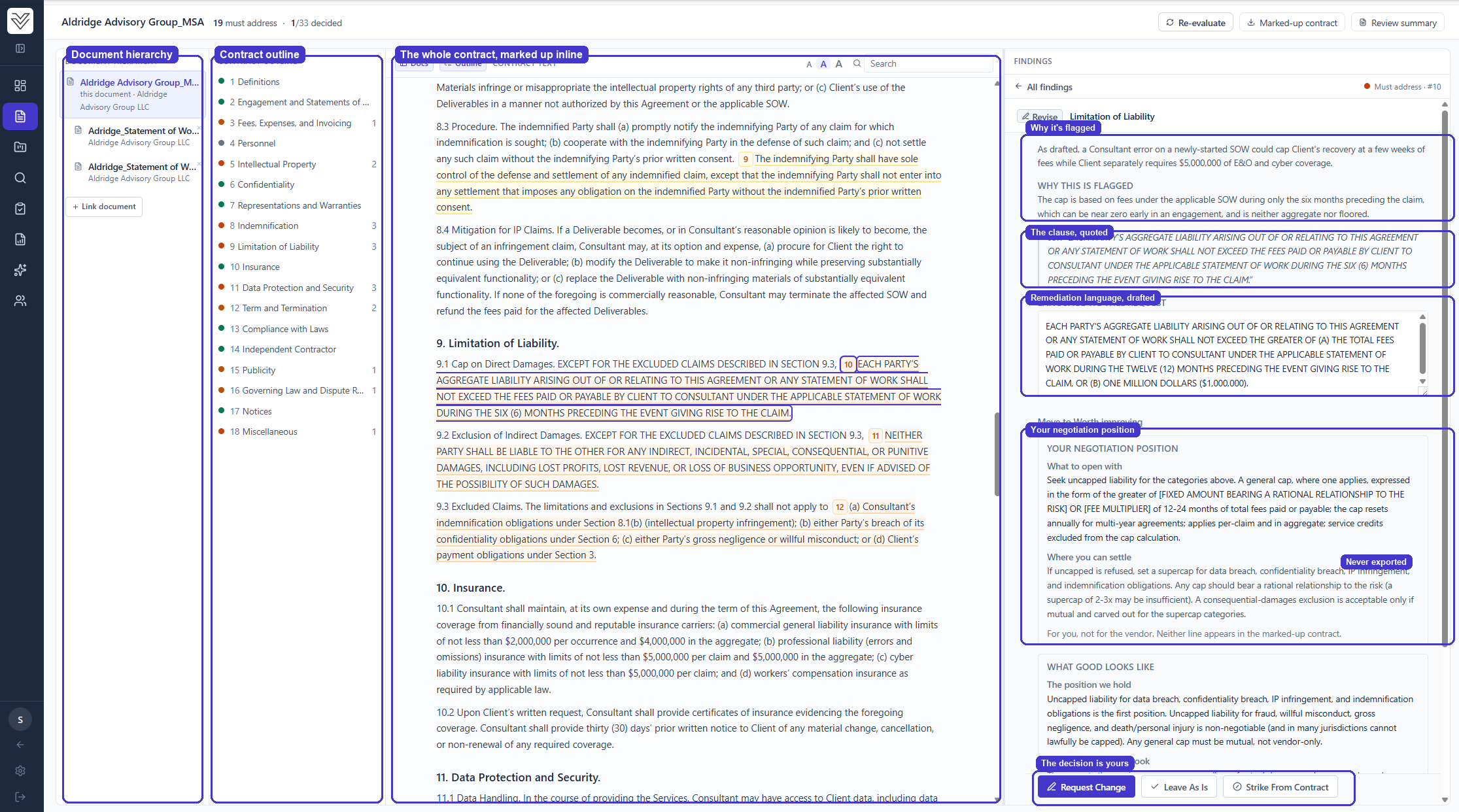
The contract itself, rendered whole, is the center of the product. Findings annotate the document in place: color-coded markup in the text, numbered chips in the margin, the full story of each finding one click away: what we found, why it matters, the evidence, the drafted language, the position to take. The drafted language is yours to edit in place; your wording is what goes out the door, and the system remembers it for next time. Your team decides each finding, every decision an ask aimed at the vendor, not paperwork aimed at your team, and the marked-up contract assembles on screen as the decisions land. Every decision is reversible until export, and every action is logged with attribution and timestamp to an append-only record: rounds are history, and history does not get edited.
The workspace is built for the way deals are actually read. The deal rail holds the whole document family, master agreement, SOWs, amendments, as one tree; find-in-contract jumps between hits; and text-size presets scale the entire surface for long reads. And the vendor-ready export is gated: the marked-up contract cannot leave the platform while a must-address finding sits undecided.
Cross-clause conflicts are held the way they exist. When a limitation of liability quietly guts an indemnity many pages away, both spans are flagged as one finding: two places in one document disagreeing, examined together.
RCI also holds your full negotiating position on every term: the floor you won’t cross, the opening you lead with, and the point where you’d shake hands. Only the opening ever leaves the building. The settle point is not in the marked-up contract and not in the summary, and there is no setting to change that, because we didn’t build a wall with a door in it. A tool that knows your bottom line has one job above all the others: keep it.
Two exports leave the platform: a marked-up Word contract ready to send to the vendor, and a review summary for your stakeholders. Nothing else has a path out.
Straight answers
The questions diligence actually asks
What did the evaluation actually check?
Every evaluation ships with its coverage receipt: the full list of standards checked, each with a verdict, including the ones that came back clean. You never have to wonder what the platform looked at. The receipt is the answer.
How do I know a finding is real?
Every finding cites the verbatim contract language it rests on, and clicking it puts that clause in front of you. Findings the platform can't cleanly locate in the text are flagged as such rather than hidden. You're never asked to trust a claim you can't check against the paper in one click.
What happens if a read is incomplete?
It fails, loudly, and your team sees a failure, not a result. The platform never repairs a truncated evaluation into something that looks finished, because a thin answer styled as a complete one is the single thing a review tool must never produce.
Does our data train your models?
No. Your contracts and decisions stay in your workspace, are used only for your evaluations, and are exportable in full at any time. The frontier AI providers the platform uses process data under commercial terms that prohibit training on it.
Does it need access to our systems?
No. You provide contracts as PDF or Word documents, and scanned paper is included: PDFs without a text layer are read too. No CLM or DMS connection is required. When a customer needs an integration, that's an API-first conversation; we don't build speculative integrations.
Is this a CLM?
No. RCI doesn't do storage workflows, approvals routing, assembly, or e-signature. It reads deals before you sign them and reads signed paper like an auditor. It sits beside your CLM.
Can't we just use a general-purpose AI tool?
You can, and you'll get a competent generic read: boilerplate every time, no memory of your standards, your risk posture, or last quarter's redlines. RCI runs the same class of frontier reasoning, carrying your codified standards and your team's decision history into every read.
Will it act without us?
No. Every finding requires a decision by your team, every decision is attributed and logged, and nothing reaches the vendor without a human choosing to send it. The platform proposes; your team disposes.
What happens when a contract term favors us?
The receipt records that the term was checked and that it deviates in your favor, and the platform says nothing to the vendor. RCI is an advocate, not a fairness engine: it will never volunteer language that fixes the other side's mistake. The silence is deliberate, and the receipt makes it auditable.
Can it read scanned contracts?
Yes. PDFs without a text layer, the decades-old paper that exists only as a scan, are read through an OCR fallback and evaluated like any other contract. Old paper is exactly what a portfolio audit is for.
Does it score or grade contracts?
No. RCI produces no composite scores and no letter grades. A score hides the reasoning; the product shows it: findings with the contract language quoted, drafted asks, and a receipt of everything checked. What you act on is the finding, not a number.
Is RCI software only, or do people come with it?
Both, and the software leads. RCI is software and a service: a bench of dedicated procurement advisors, senior people with decades of procurement and corporate legal experience, some of them attorneys, available at every step when you want them, from initial implementation and standards codification to negotiation support with your vendors. They are the people who codified the standards inside the platform, and they stay with your team.
What's your security posture?
Workspace isolation is architectural: your data and standards are scoped to your workspace by construction. Access is role-based at the account and workspace level, gating who can upload, evaluate, decide, and export, and workspace membership is the only path in. Every meaningful action is logged with attribution to an append-only record. SOC 2 Type 2 readiness work is underway. Behind-firewall and dedicated-infrastructure deployment are available conversations for enterprise requirements.
For questions past this page (model choices, retrieval mechanics, deployment specifics), we’re happy to go deeper in a technical conversation. The architecture produces observable outputs, and seeing them on real paper beats another page of description.